

 Facebook
 X
X
 Pinterest
 Copy Link

Life After Closing — Practical Ownership in Your First Year (Home Buying Step 13)
Life after closing is part of my practical, experience-based Home Buying Series. Step 13 assumes you’ve already closed, taken possession, and lived in the home long enough to realize the truth: owning is different than buying. The goal here is to help you avoid the common “first-year mistakes” that quietly drain budgets and create avoidable stress.
- Step 1: Know Your Credit
- Step 2: Build a Sustainable Budget
- Step 3: Choose a Lender Who Explains, Not Sells
- Step 4: Fixing Underwriting Issues (“Not Yet” Is Not “No”)
- Step 5: How to Choose a Realtor Who Works for You
- Step 6: Mortgage Types Explained for Buyers
- Step 7: Start Looking at Houses the Right Way
- Step 8: Narrowing the Field
- Step 9: Make an Offer on a House in Texas
- Step 10: Your Offer Is Accepted — What Happens Next in Texas
- Step 11: Closing on a House in Texas — The Final Stretch Before Funding
- Step 12: Closing Day in Texas — Signing, Funding, and Your First 30 Days
In the first year, most homeowners learn the same lesson in different ways: life after closing is very different than the buying process itself. The “house payment” is only one line item. The real challenge is everything that shows up after—escrow changes, insurance increases, maintenance, utilities, and the temptation to celebrate with purchases that don’t fit the new budget.
First-Year Reality Check: Revisit Your Budget (Yes, Again)
One of the biggest adjustments in life after closing is realizing how different your monthly reality looks compared to your pre-purchase estimates. If you read Step 2, you already know I’m going to say this: update your budget for the new reality. Homeownership changes your monthly baseline in ways buyers rarely estimate accurately.
- Utilities may be higher (or lower) than expected—especially if you moved from an apartment or from a smaller home.
- Maintenance is no longer optional. Small problems become expensive problems if you ignore them.
- Insurance and escrow can change—sometimes dramatically—after you close.
In many cases, you can request prior-year usage or billing history from utility providers. That gives you a real benchmark instead of guessing. Your goal isn’t to “win” budgeting. Your goal is to stay comfortable and solvent while the house becomes normal.
Escrow Shock: Why Your Payment Can Change After Closing
I fielded a lot of calls about escrow shock when I worked at USDA, and it still catches homeowners off guard. Escrow shock is one of the most common surprises homeowners face in life after closing, especially in Texas, where insurance and taxes have risen dramatically in the last few years.
Escrow is your lender collecting money for property taxes and homeowners insurance as part of your monthly payment. If taxes rise, or insurance rises, or the escrow account comes up short, your monthly payment can change—even if your interest rate stays the same.
In Texas, as weather patterns shift, insurance costs can climb. More hail, more wind, more fires, and more claims can mean higher premiums. The practical move is not panic—it’s attention:
- Review your annual escrow analysis when it arrives.
- Shop insurance yearly to make sure your premium is in a reasonable range.
- Don’t assume “shopping” means “switching.” It means staying informed.
The other part of the escrow puzzle is taxes. While most CADs try to keep neighborhoods evaluated similarly, you can sometimes end up being the outlier. If you’re the cheapest valuation on the block, you don’t want to point that out, but if you end up the highest for some reason, reach out to the Realtor who helped you buy the house and see if they’ll do a market valuation for you. Most of the time it’s free (as it is a tool we use when folks are thinking about selling).
Bear in mind that if all home values around you have gone up, you can’t win if your argument is, “I’ve done nothing, the value should remain the same.” Your argument should be: “My home is valued at X by you, these 5 similar homes in the neighborhood are X-$10,000 (or whatever).”
Ultimately, any protest is filed directly with the appraisal district and must follow their formal process and deadlines.
Texas Homestead Exemption: The “First-Year Paperwork” That Actually Lowers Your Taxes
If you’re living in the home as your principal residence, one of the simplest ways to reduce your ongoing costs is filing for the Texas residence homestead exemption.
This is not a loan thing and not a Realtor thing—it’s a property tax thing, and it’s handled through your county appraisal district, not your lender.
At a high level, the general homestead exemption reduces the taxable value of your home for certain taxing units (especially school district taxes), and it also ties into a separate protection many homeowners don’t understand until they miss it: Texas law limits how fast the appraised value for tax purposes of a residence homestead can increase year over year (the well-known “10% homestead cap,” with rules and exceptions).
How to file (Texas Form 50-114)
- File with your county appraisal district (not with the Texas Comptroller).
- Timing: filing is generally done between January 1 and April 30 for the year you’re claiming the exemption. Late filing is possible in some cases, but don’t treat that as a strategy.
- ID matters: the application typically requires a copy of your Texas driver’s license or state ID, and the address must match the homestead property address (with limited exceptions).
- One homestead per person: you’re affirming you do not claim a residence homestead exemption on another property (in Texas or outside Texas).
- Once granted: you generally do not reapply every year unless the chief appraiser requires it—still, keep an eye on your annual appraisal notice to confirm the exemption remains in place.
If you inherited a property, or the deed/ownership paperwork is unusual, homestead can still be possible—but it may require extra documentation. Texas does have specific rules for “heir property” scenarios, and that can mean affidavits or supporting paperwork.
Practical takeaway: If you bought a home and moved in, put “Homestead filed?” on your first-year checklist right next to “Change locks” and “Set up utilities.” It’s one of the rare pieces of homeownership paperwork that can pay you back every single year.
Taylor County shortcut: Taylor Central Appraisal District has an online Forms page. Expand the Exemptions section to find the Homestead Application and the Disabled Veteran’s (or Survivor’s) Exemption options.
Note: Taylor CAD also reminds homeowners that it is free to file a homestead application—be cautious of anyone trying to charge you to “process” it.
Ownership Rules of Thumb: What Prevents Most First-Year Problems
These rules of thumb come directly from what I’ve seen trip people up most often in life after closing, particularly during the first year.
Ownership Rules of Thumb (First Year)
- Revisit your budget. Your payment is only the start—utilities, maintenance, and escrow changes are the real test. Go back to Step 2 and update your “new reality” numbers.
- Expect escrow changes. Taxes and insurance can rise after purchase. Review your escrow statement and shop insurance periodically so you know what “reasonable” looks like. If your taxes rise, have they risen for your neighbors too?
- File your homestead exemption. If this is your primary residence, file Form 50-114 with your county appraisal district (generally Jan 1–Apr 30). It’s one of the few pieces of paperwork that can reduce your taxes and help control year-over-year appraisal increases.
- Fix water, pests, and outside leaks immediately. Water intrusion, sewer issues, rodents/bugs, and anything that lets the elements into walls gets worse—and more expensive—over time.
- Delay big purchases. Don’t celebrate with a house full of furniture bought on credit. Build slowly. Keep your cushion.
- Live through all seasons before major upgrades. Don’t remodel based on week one. See how the house behaves in summer heat, winter cold, and heavy rain before you spend big.
- Change HVAC filters on schedule. Set a recurring order and change them when they arrive. It’s one of the cheapest ways to prevent expensive HVAC problems.
- Get multiple quotes for major repairs. HVAC, roof, plumbing, electrical—prices can vary wildly. Compare scope, warranties, and whether permits are pulled when required.
- Document everything. Keep a simple file (paper + digital) for major repairs, invoices, permits, and warranty info. Your future insurance claim or resale inspection will thank you.
- Plant for the long game. Trees and basic landscaping pay dividends in comfort and long-term value. Don’t plant trees too close together—competition kills long-term growth.
- Don’t panic if you’re “upside down” early. That can be normal in the first few years. Equity is a time game. Stay steady, follow your budget, and maintain the home.
What to Fix Immediately (And What Can Wait)
Not every issue is an emergency. But some problems deserve fast action because they compound quickly:
- Water and sewer leaks (even “small” ones)
- Pest intrusions (bugs, rodents, termites)
- Any breach that lets the elements into the structure (roof, flashing, siding, trim gaps, rot points)
Meanwhile, cosmetic projects can usually wait. Many homeowners do it backwards—spending money on finishes while ignoring the boring stuff. The boring stuff is what protects the house.
I grew up working in my parents’ tire store. The car equivalent of this is a new set of shiny wheels on a car that is pouring oil or unsafe to drive. Yeah, it looks cool, but it didn’t actually fix the issues that were the problem.
Utilities and Efficiency: The Cheapest Comfort Upgrade Is Often Insulation
One of the first practical upgrades I like in many homes is attic insulation. It’s not glamorous, but it can be high impact—especially in West Texas. If your inspection mentioned insulation levels, that’s worth addressing early.
Some energy providers and generators offer rebates, audit programs, or educational resources that help homeowners reduce costs (insulation, weather-stripping, efficiency improvements, and similar). It’s worth checking what’s available in your area. In Texas, AEP is a generator for a large portion of the state, you can find out more about their programs here.
One caution: insulation work is usually straightforward, but pay attention to safety. Don’t block ventilation. Don’t bury fixtures that shouldn’t be buried. And don’t fall through the ceiling—also don’t ask how I know that.
The Contractor Reality: You Don’t Need to Be Handy, But You Do Need to Be Competent
I’m not here to pretend everyone needs to become a handyman. But the real world requires two skills:
- Knowing what you can do safely (and what you shouldn’t touch)
- Knowing how to hire well (and protect yourself when you hire)
For major systems—roofing, electrical, HVAC, plumbing—get multiple quotes. I’ve seen the same home get bids that varied by five figures. Higher price does not automatically mean higher quality. Read scopes. Ask what is included. Ask about warranty terms. And ask whether permits are required and will be pulled.
If a licensed contractor won’t fix a legitimate issue, your leverage is often the licensing agency. Documentation matters. Paper trails matter.
Permits, Proof, and Receipts: Protect Future-You
Hiring well is only half the equation—documenting the work is what protects you later. Sometimes permits are your only “proof” later—especially with insurance claims. Even when permits aren’t required locally, documentation still matters. Keep receipts and invoices for major work, and keep them in a place you can actually find.
My recommendation is simple:
- Keep a basic home folder (physical file + digital scans).
- Save invoices, warranties, manuals, and contractor contact info.
- Track dates for major repairs (roof, HVAC, plumbing, electrical).
This is not busywork. It’s how you avoid headaches when you sell, refinance, or file a claim.
Trees and Landscaping: The Investment Landlords Don’t Make
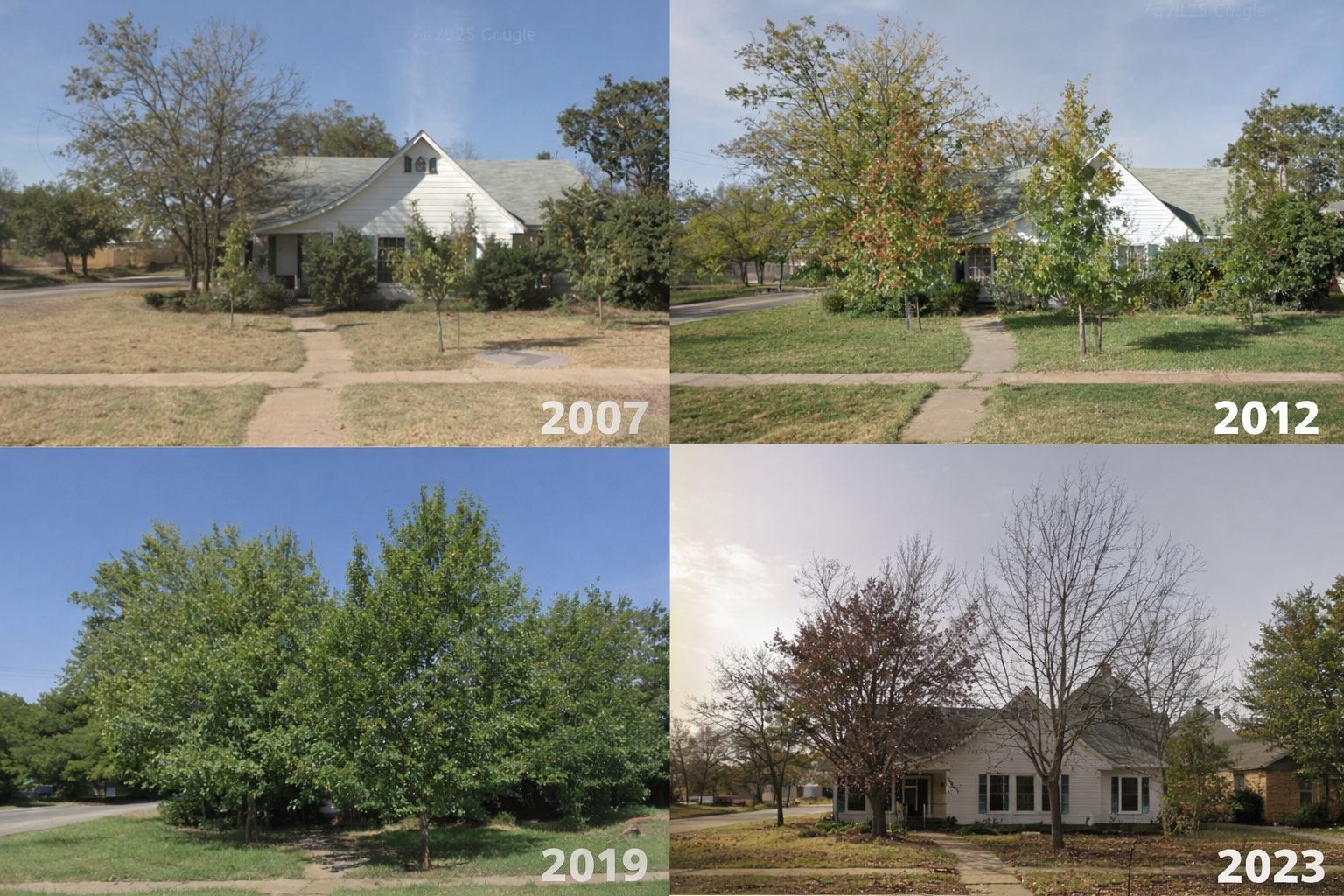
The same home over time.
Tree growth and landscaping changes compound slowly, but the comfort and efficiency gains become dramatic over the years.
Trees are one of the best long-term investments homeowners can make—comfort, shade, curb appeal, and often resale value. They are also one of the easiest “tells” for rentals: most landlords don’t plant trees or improve landscaping. Bare yards often signal a rental. Walk your neighborhood, make guesses which are rentals and which are owned, then you can usually verify ownership through the local appraisal district website.
If you plant trees, space them correctly. Don’t plant in tight pairs like people often do early on. Over time, trees compete, and you lose one (or both). Plant for what the tree will be in 10–20 years, not what it looks like today. Many nurseries will give you advice on planting.
Furniture on Credit: The Most Common “I Didn’t See That Coming” Mistake
Buying a house triggers a natural impulse: “Now we need everything.” That urge is understandable. It can also wreck a budget.
The single biggest mistake I see is a new homeowner filling the house with new furniture bought on credit. The cushion disappears, the payment stress rises, and the home becomes a financial choke point.
Better strategy: buy slowly. One piece every couple of months. Estate sales, antique stores, and thrift shops can produce better quality for a fraction of the cost—and the hunt is part of the fun.
A Quick Word on Solar
Be cautious with solar sales pitches. Many companies sell panels, not verified long-term savings. Some homes are poor solar candidates due to orientation, roof angles, or shade—yet homeowners still receive aggressive sales calls.
If you ever consider solar, treat it like a major financial decision:
- Read the contract carefully (especially liens, transferability, and escalators).
- Compare financing structures (loan vs. lease vs. Power Purchase Agreement (PPA), where you buy the power but do not own the panels).
- Ask how it affects resale and underwriting.
- Verify assumptions, not marketing claims.
In practice, solar is rarely a value add in this market. I have not seen buyers assign meaningful resale value to solar systems, and I have seen many transactions complicated—or stalled entirely—by solar obligations that outlast the seller’s ownership.
Some solar agreements create liens, UCC filings, or contractual obligations that must be satisfied before selling or refinancing. In many cases, the remaining balance must be paid off at closing, even when buyers assign little or no value to the system itself.
A UCC filing is a public notice that a solar company or lender has a secured legal claim on the solar equipment, which often must be released or paid off before a home can be sold or refinanced—even if the system adds little or no resale value.
Solar is best understood as a personal energy decision, not a guaranteed property upgrade.
I’ve also seen solar complicate roof repairs and replacements. Panels often need to be removed and reinstalled, which adds cost, coordination risk, and finger-pointing when leaks or damage appear. In some cases, the solar installation itself has created roofing problems that didn’t exist before.
Solar may lower your utility bill, but that does not mean it raises your home’s market value.
Life After Closing: Don’t Panic About Equity
Here’s a truth that gets lost online: it can be normal to feel “upside down” early. Between closing costs, amortization, and market movement, the first few years aren’t always where you feel equity growth.
During the housing crisis, many homeowners who could afford their payments still walked away because they were scared by headlines and were temporarily upside down. Many of them would have been far better off staying put.
The practical takeaway is simple: don’t freak out, don’t make big changes, and live your life inside the budget you built. Equity is usually a time game.
Home Value Tracking: Useful, Not Gospel
Many REALTORS® can set you up for periodic home value updates based on area sales. Those automated estimates aren’t perfect, but they can be helpful as a general trend line. You can also claim your home on major portals so you can track updates and comparable sales over time.
Just remember: automated values are not appraisals, and they’re not a substitute for a CMA when you’re making real decisions. Also, claiming your home on sites like Zillow or Homes.com can be fun, but I’m sure can lead to prospecting by Realtors, too.
Why Step 13 Matters
The buying process is structured. Homeownership is not. The first year is where people either build stability—or accidentally create stress that follows them for years.
If you do nothing else, keep it simple: revisit your budget, address compounding problems early, document major work, avoid new-debt celebrations, and make thoughtful upgrades after you’ve lived through the seasons.
Life after closing rewards steady habits, realistic budgeting, and patience far more than spur-of-the-moment decisions made under stress.
If you’re wondering how equity actually builds in the early years, that’s a selling and refinancing question, and it’s addressed Home Selling Series.


About Me — Doug Berry, MBA, REALTOR®
The Bow Tie Agent
I’m a REALTOR® with Better Homes & Gardens Senter, REALTORS® who focuses on helping buyers understand the real-world side of homeownership — from lending and budgeting to navigating underwriting without surprises. With an MBA and experience as a lender with USDA Rural Development’s mortgage programs, I approach the process the same way I do with clients: clearly, calmly, and without sales pressure.
If you have questions about this step, need help preparing for a home purchase, or want a second set of eyes before making an offer, feel free to reach out:


